
What to expect
We are beginning a fascinating journey through Galilee.
Nazareth is a city in Galilee, a holy Christian city, the third most important after Jerusalem and Bethlehem. According to one theory, the name "Nazrat" comes from the Hebrew noun Netzer, meaning growth, that is, refers to "Pawling of Davidov", to the descendants of which the residents of the village considered themselves. In Nazareth, according to legend, an angel brought the good news to the Virgin Mary, and here Jesus spent his childhood. The city attracts a huge number of pilgrims from all over the world.
In modern Nazareth is the grotto of the Annunciation, over which the largest Catholic Basilica of the Annunciation in the Middle East is built, as well as the picturesque Orthodox Church of the Archangel Gabriel above the source of the Virgin Mary, and other Christian churches.
Next, we will visit Canna of Galilee, a small Arab village on the way from Nazareth.
The Bible mentions that it was here that Jesus performed his first miracle, the transformation of water into wine at a wedding where he was invited with his disciples and the Virgin.
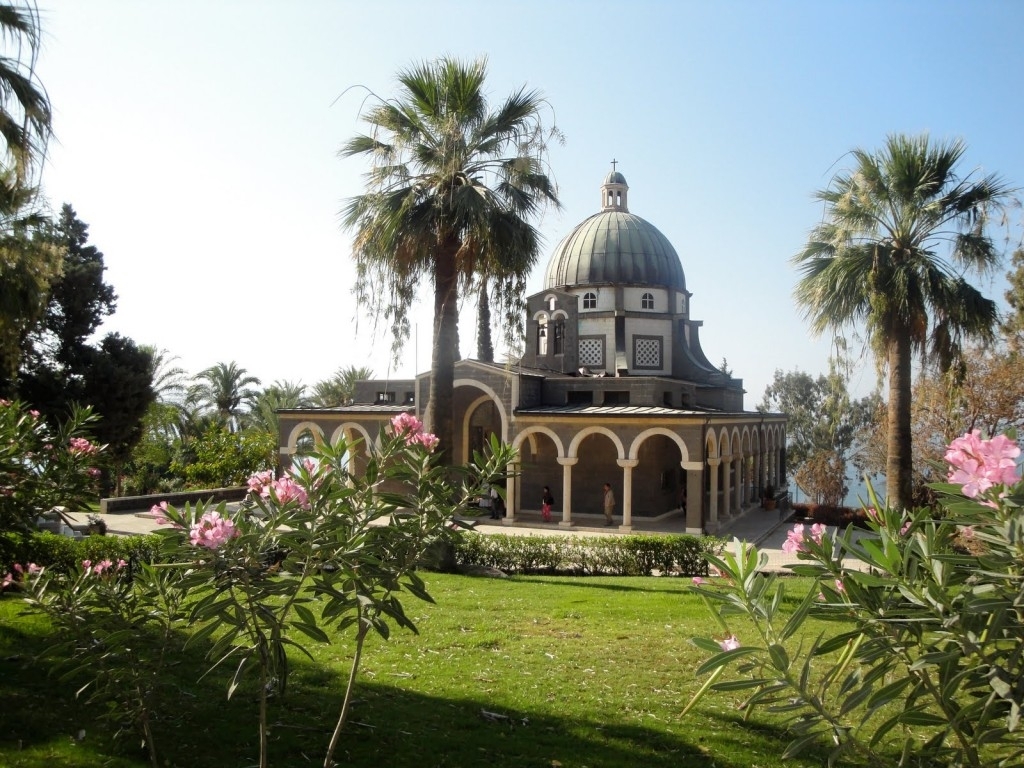
In Galilee, at the northern end of the Sea of Galilee (Lake Kinneret), is the temple of the Twelve Apostles.This cathedral is the Cathedral of the Holy Glorious and All-Valvet Twelve Apostles. The features of this building are pink domes (unlike the traditionally blue ones). This church can be seen from afar. In honor of this church, the feast of the Orthodox Church is celebrated on July 13.
Then we will visit Tabhu, the place where the Saviour created another miracle – the miracle of the reproduction of fish and bread. Around 383, the pilgrim Egeria visited the holy places in Tabha and left a record that has survived to the present day. She claimed that the stone on which Jesus Christ laid the bread was now used as the altar around which the church was built. In 614, during a Persian attack, the church was destroyed. For more than 1,300 years, these holy sites were hidden under ashes. It was only in 1892 that archaeological excavations began. During excavations in the altar part, a lime monolith was found. It is not known if this stone is the one Egeria wrote about, but it was placed under a modern altar. The modern Church of the Multiplication of Bread and Fish was built in 1982 on a Byzantine foundation and is an exact copy of the reproduction of the church of the sixth century.
In Galilee, on the western shore of Lake Taverias (Lake Kinneret), is the ancient city of Tiberias. The city is one of the four holy cities for Jews. Today, Tiberia harmoniously combines historical and cultural monuments. Tiberias attracts tourists with holy places.
Continuing our tour of the Galilee, we head to the Jordan River. To do this, we must descend to the southern tip of the Sea of Galilee. Yardenit is the place of the Jordan River exit from Lake Tiberias, as well as the center of the water dipping ceremony, where a symbolic dipping ceremony takes place for the faithful of the Greek Orthodox Church, Catholics and Christians of all faiths. According to Mark, at the time of his baptism in the waters of the Jordan River, a holy spirit descended on Jesus in the form of a dove, and everyone heard a voice from heaven: “Here is my beloved son, in whom I am well pleased.”
Thousands of pilgrims come here every day. All who have visited this sacred place, say that there is awe, inspiration and blissful delight.
Details
- Интересы
- Obzornye ekskursii
- Способ передвижения
- Avtomobil ili avtobus
Discuss the details in chat
Message a specialist right away or choose an option first. We will agree the dates, itinerary and final price in chat.