

Clear booking

Choose a format, party size and date

See the matching price and available dates first. Then send the organizer a complete request without repeating the details.

About this offer

What to expect

1 Day

Arriving in Barcelona. Group transfer and accommodation in the hotel. At the reception you will be waiting for a package of documents on the tour, a tourist memo and a map of the city in Russian. Overnight.

2 -7 Day

Barcelona, just together. Breakfast. Free stay in Barcelona on an independent program. You can visit without queue 6 museums on the Artiquet card (the Picasso Museum, the Juan Miro Foundation, the Museum of Catalan Art, the Museum and Fund of Contemporary Art, the Antonio Tapies Foundation), ride a two-storey bus in Barcelona with stops (the tour is recorded in Russian), visit the Shopping Outlet “Roca Village”, other museums and shops of the city.

Pablo Picasso Museums in Spain. The founder of Cubism, the most expensive artist in the world, the best artist of the last century, the most “abducted” artist – all this is Pablo Picasso. The Picasso Museum is an art museum with the largest collection of works by the legendary master. The museum is among the 40 most visited in the world.

The buildings where the museum is located, the sights themselves - a complex of five ancient city houses, the main of which is the palace of the family d'Aguilar, built in the Renaissance.The two-thousandth museum has undergone a serious reorganization and expansion, acquiring, among other things, one modern building.

At the moment, the museum’s collection has more than 3,500 exhibits and is divided into three sections: paintings and drawings, engravings and ceramics. These are divided into three main parts, identifying the periods of Picasso’s work – his early years, his training and creative life before 1917. The Achilles heel of the museum is the artist’s late works, there are few of them in the collection. However, one of the gems of the museum is the full series of Las Meninas, donated by Picasso himself in 1968 in memory of his deceased friend Sabartes. Every year the museum’s already exceptional collection is replenished.

The institution is engaged not only in the exhibition of legendary art objects, but also in a wide range of educational and scientific programs, which annually attracts not only “civilian” tourists, but also people for whom art is part of work or training.

Barcelona’s Picasso Museum is trying to keep up with modern technologies – it is actively represented on the web and has been repeatedly noted for various multimedia projects. Part of the collection can be found in absentia and informatively on the official website of the museum.The Juan Miro Foundation. Joan Miro is considered one of the most brilliant Spanish avant-garde artists of the XX century, whose life and work are inextricably linked with Barcelona. Miro, like Dali, who worked in the genre of surrealism, was the real pride of Catalonia. So it is not surprising that the center of arts in his name appeared during the life of the artist. The Joan Miro Foundation was opened on June 10, 1975. Its roots go back to 1968, when the largest exhibition of works by the Catalan artist and sculptor took place in the ancient hospital of the Holy Cross. At the same time, the idea of creating such a Foundation-Museum that would unite not only the work of Miro, but also become an exhibition platform for other contemporary artists, including young ones, which the artist himself wanted. At that time, Barcelona and its contemporary art needed such a venue as a breath of fresh air. It is worth noting the full name of the Foundation – the Center for the Study of Contemporary Art.

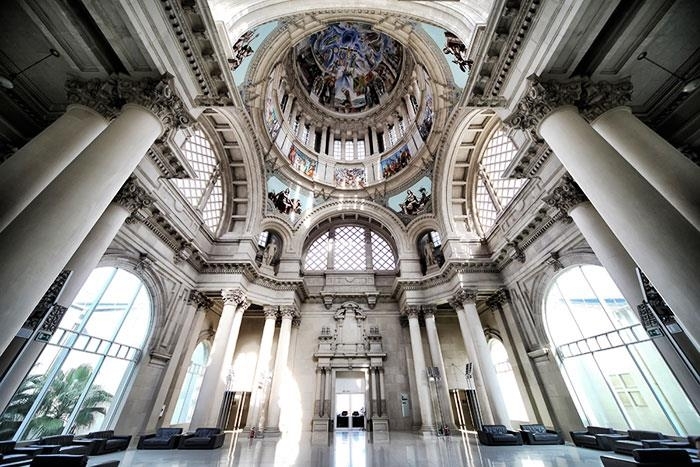
Museum of Catalan Art. The National Museum of Art of Catalonia (MNAC) is located in the National Palace, an imposing building built in the northern part of Mount Montjuic as the main pavilion for the 1929 World Exhibition.The palace was supposed to be demolished at the end of the exhibition, but it was preserved and in 1934 became home to an art collection that focuses on Catalan artists and their works.

The National Museum of Art of Catalonia (MNAC) boasts a unique collection of Romanesque art with a large number of frescoes, many of which came from abandoned churches in the nearby Pyrenees. One of the many attractions of the museum is a fresco once located in the apse of the Church of Sant Clement in Taul, a small village in the north of Catalonia. The painting with a strong Byzantine influence, known as Christ in Glory, presents a colorful depiction of Christ. The National Museum of Art of Catalonia (MNAC) has a unique collection of painted panels from the 12th and 13th centuries, as well as wood carvings, sculptures and works of art made of metal.

The collection of Gothic artworks will impress you with a unique collection of religious wooden panels from the 13th to 15th centuries. Most of the Catalan and Valencian schools were heavily influenced by the Gothic art of Italy and France.

Works by famous artists from many countries of Europe of the 16th-18th centuries are exhibited here. Some of the more famous names include Titian, Rubens, Velázquez and Francisco de Zurbaran.

At the Gallery of Contemporary Art of the National Museum of Art of Catalonia (MNAC), visitors will find an interesting collection that was previously exhibited in its own museum in the Citadel Park. It features mainly works of Catalan art from the 19th to 20th centuries, a time when modernism flourished and especially the local interpretation of Art Nouveau style, which reached its peak.

Museum and Foundation of Contemporary Art. The Museum of Contemporary Art of Barcelona is located in a building created by the famous architect Richard Mayer, in the Raval quarter, in the historic center of Barcelona, next to the Center for Contemporary Culture. The permanent collection of the museum is replenished with funds provided by the government of Catalonia, the City Hall of Barcelona and the Foundation-Museum of Modern Art, and has more than 5,000 exhibits, most of them representing Catalan art and having had an important influence on it of the direction of foreign art.The collection of the MACBA Museum reflects the history of the development of avant-garde art from the beginning of the second half of the twentieth century to the present day. The exhibition features works by artists and sculptors not only in Catalonia but also throughout Spain and beyond. The MACBA collection features Michel Barcelona, Jean-Michel Basquiat, Miguel Angel Campano and Antoni Tapies, as well as many other outstanding masters. In addition, various traveling exhibitions and conferences dedicated to avant-garde art are periodically held here.

The Antonio Tapies Foundation. The most interesting fund of Tapies with the center of cultural studies and the personal museum of the artist is located in the first building in the modernist style. It was created by the Catalan painter himself with the aim of exploring and further developing contemporary art throughout the city. The museum of Tapies has the best collection of works of the representative of abstract expressionism, consisting of 2000 unique drawings, paintings, engravings and sculptures. Numerous exhibitions of other popular painters are regularly held in the halls. Here symposiums and lectures are organized, films are shown, publications are issued.The library with the richest collection of books on contemporary world art deserves special attention. The building also has a complete archive of original works by the Catalan artist and sculptor.

8 Days

Airport. Breakfast. Group transfer to the airport. End of tour.

Reviews